Isaac Rosenberg 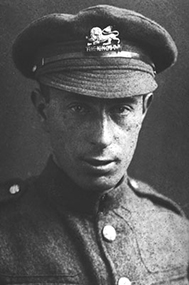
Isaac Rosenberg grew up in the poverty stricken East End. His father, a Lithuanian refugee, worked as a peddler, but also wrote Hebrew and Yiddish poetry, a love he shared with his son.(1) With the support of wealthy Jewish patrons, Isaac attended the Slade School of Art where he joined the renowned ‘Whitechapel Boys’.(2)
As opportunities in the Arts disappeared, he made plans to enlist with the RAMC. In 1915 Rosenberg joined the only battalion that would accept men of his short stature, the Bantam’s of the 12th Suffolks.(3) Physically frail and with a recurrent lung condition he found army life unyielding ‘sent from unit to unit and task to task'.(4)
In the Summer of 1917 assigned to the RE unit of the King’s Own Royal Lancaster’s he composed ‘Returning we hear the Larks’.(5) Here the sky has a ‘beauty that can hide a storm of death as easily as it produces music’, and Rosenberg becomes a spokesman for all the ironies of war that can never be explained.(6)
Private Rosenberg re-joined the KOR’s in the trenches just prior to the German Spring Offensive. On the 28 March the 3rd Army found themselves on the new front line as the Germans broke through again. Survivors were ordered back for respite, yet Rosenberg remained. On the night of 1 April 1918, he set off on wiring patrol, but did not return.(7)
Through the tireless efforts of his sister Annie and Georgian Poet, Gordon Bottomley, a volume of his works(8) including ‘Break of Day in the Trenches’(9) was published following his death.
RETURNING, WE HEAR THE LARKS by Isaac Rosenberg
Sombre the night is:
And, though we have our lives, we know
What sinister threat lurks there.
Dragging these anguished limbs, we only know
This poison-blasted track opens on our camp -
On a little safe sleep.
But hark! Joy - joy - strange joy.
Lo! Heights of night ringing with unseen larks:
Music showering on our upturned listening faces.
Death could drop from the dark
As easily as song -
But song only dropped,
Like a blind man’s dreams on the sand
By dangerous tides;
Like a girl’s dark hair, for she dreams no ruin lies there,
Or her kisses where a serpent hides.
Nemo enim ipsam voluptatem quia voluptas sit aspernatur aut odit aut fugit, sed quia consequuntur magni dolores eos qui ratione voluptatem sequi nesciunt. Neque porro quisquam est, qui dolorem ipsum quia dolor sit amet, consectetur, adipisci velit, sed quia non numquam eius modi tempora incidunt ut labore et dolore magnam aliquam quaerat voluptatem.
Nemo enim ipsam voluptatem quia voluptas sit aspernatur aut odit aut fugit, sed quia consequuntur magni dolores eos qui ratione voluptatem sequi nesciunt. Neque porro quisquam est, qui dolorem ipsum quia dolor sit amet, consectetur, adipisci velit, sed quia non numquam eius modi tempora incidunt ut labore et dolore magnam aliquam quaerat voluptatem.
Nemo enim ipsam voluptatem quia voluptas sit aspernatur aut odit aut fugit, sed quia consequuntur magni dolores eos qui ratione voluptatem sequi nesciunt. Neque porro quisquam est, qui dolorem ipsum quia dolor sit amet, consectetur, adipisci velit, sed quia non numquam eius modi tempora incidunt ut labore et dolore magnam aliquam quaerat voluptatem.
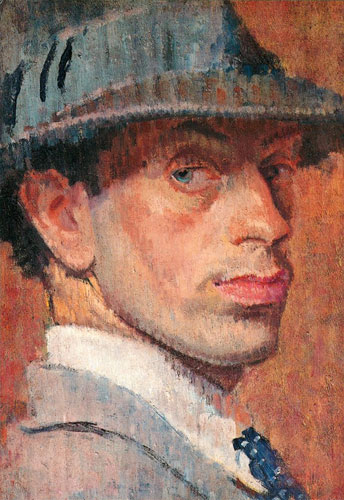
Self Portrait Isaac Rosenberg - oil on panel - 1915
(Painted in the year Rosenberg enlisted. Despite being a pacifist, he believed ‘we must all fight to get the trouble over.’)
Given by the sitter's sister, Annie Wynick (née Rosenberg), 1959
Notes:
1. Ed. Powell, Ann, A Deep Cry; Soldier-Poets killed on the Western Front, The History Press (2014), page 350
2. London Jews of the First World War - www.jewsfww.london
3. Ibid, A Deep Cry, page 351
4. Moorcroft Wilson, Jean, Isaac Rosenberg page 390-1 – A Century Back Feb 2018
5. Rosenberg, Isaac - Returning, we hear the Larks - Ed. Bottomley, Gordon, William Heinemann (London) (1922)
6. Stephen, Martin, Poetry & Myths of the Great War, Pen & Sword Military Books (2014), page 219
7. Ibid, A Deep Cry, page 360
8. Ibid Poetry & Myths of the Great War, page 212
9. Rosenberg, Isaac - Break of Day in the Trenches - First published Dec 1916 Issue Chicago journal ‘Poetry’
© Copyright 2026. All rights reserved.


