
Nowell Oxland
Nowell Oxland was the youngest son of the Vicar of Alston in the High Pennines. His most famous poem 'Outward Bound'(1), written on route to Gallipoli in July 1915, invokes the invasion by the Greeks at Troy across the Dardanelles (2), but draws us back to the rolling hills of Cumberland. Landing at Suvla Bay on 6 August 1915 his Battalion prepared to attack the following day. Oxland died of wounds two days after the 6th Border's Brigade had taken Green Hill and Chocolate Hill. He was buried in the Green Hill Cemetery, Gallipoli.(3)
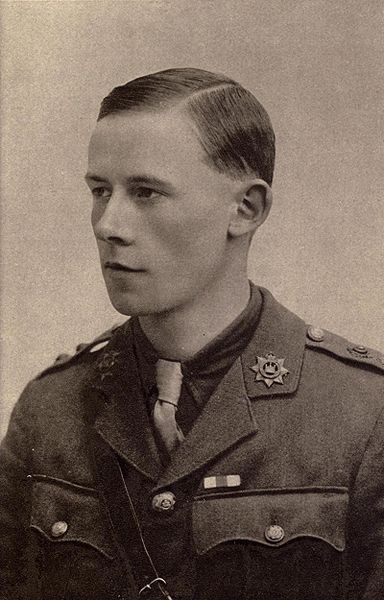
Durham school pal William Noel Hodgson, the renowned war poet Edward Melbourne (4), fighting with the Devonshire Regiment was devastated to learn of his friend's death and composed a poem in his memory.(5)
In a letter to his sister Stella he wrote;
“Thanks very much for the moss from the Gable, which I burned at evening
in memory of Oxland who died in the Dardanelles a fortnight… ago, and was
my great companion in my hill climbs. I shall miss him much; also three more
school pals who were in Saturday’s list”.(6)
Despite surviving the battlefield at Loos, Fricourt and Mametz, Hodgson too was killed in action on the first day of the Battle of the Somme 1916.
Both families released posthumous volumes of their poetry (7), however, perhaps the most poignant memorial to Oxland remains in his Father's former parish church, St Augustine's, Alston, where painted panels either side of the altar depicting St Michael and St George clearly show the face of Lieutenant Nowell Oxland.(8)
OUTWARD BOUND by Nowell Oxland (extract)
There’s a waterfall I’m leaving
Running down the rocks in foam,
There’s a pool for which I’m grieving
Near the water-ouzel’s home,
And it’s there that I’d be lying
With the heather close at hand
And the curlews faintly crying
Mid the wastes of Cumberland.
While the midnight watch is winging
Thoughts of other days arise,
I can hear the river singing
Like the Saints in Paradise;
I can see the water winking
Like the merry eyes of Pan,
And the slow half-pounder sinking
By the bridge’s granite span.
Ah! to win them back and clamber
Braced anew with winds I love,
From the river’s stainless amber
To the morning mist above,
See through cloud-rifts rent asunder
Like a painted scroll unfurled,
Ridge and hollow rolling under
To the fringes of the world.....
Nemo enim ipsam voluptatem quia voluptas sit aspernatur aut odit aut fugit, sed quia consequuntur magni dolores eos qui ratione voluptatem sequi nesciunt. Neque porro quisquam est, qui dolorem ipsum quia dolor sit amet, consectetur, adipisci velit, sed quia non numquam eius modi tempora incidunt ut labore et dolore magnam aliquam quaerat voluptatem.
Nemo enim ipsam voluptatem quia voluptas sit aspernatur aut odit aut fugit, sed quia consequuntur magni dolores eos qui ratione voluptatem sequi nesciunt. Neque porro quisquam est, qui dolorem ipsum quia dolor sit amet, consectetur, adipisci velit, sed quia non numquam eius modi tempora incidunt ut labore et dolore magnam aliquam quaerat voluptatem.
Nemo enim ipsam voluptatem quia voluptas sit aspernatur aut odit aut fugit, sed quia consequuntur magni dolores eos qui ratione voluptatem sequi nesciunt. Neque porro quisquam est, qui dolorem ipsum quia dolor sit amet, consectetur, adipisci velit, sed quia non numquam eius modi tempora incidunt ut labore et dolore magnam aliquam quaerat voluptatem.
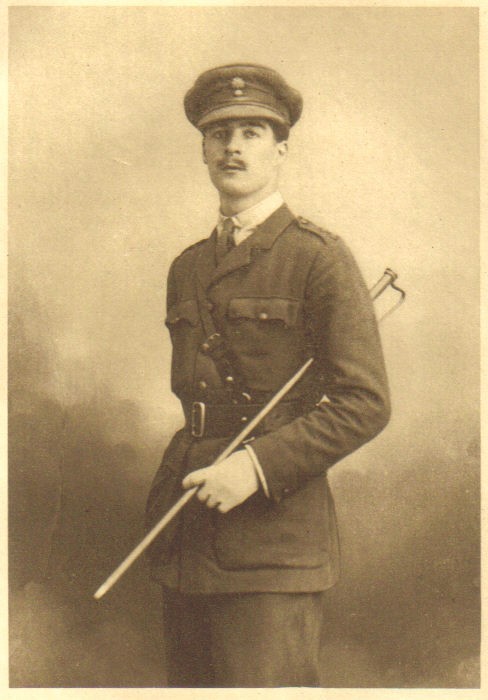
William Noel Hodgson MC c.1915
Notes:
1. Oxland, Nowell - Outward Bound - The Times (Aug 1915)
3. Cooper, Stephen - The Final Whistle: The Great War in Fifteen Players (2013)
4. Hodgson, William Noel (“Edward Melbourne”) – Before Action – The New Witness (June 1916)
5. Hodgson William Noel - In Memory of Nowell Oxland, Killed at Suvla Bay 9th Aug 1915 (1915)
6. www.acenturyback.com/2015/09/06 - Josh Levithan (6 Sept 2015)
7. www.thenorthernecho.co.uk/history - (24 Feb 2014)
8. cumbrianwarmemorials.blogspot.co.uk - Alston (24 Dec 2011)
Isaac Rosenberg
Isaac Rosenberg grew up in the poverty stricken East End. His father, a Lithuanian refugee, worked as a peddler, but also wrote Hebrew and Yiddish poetry, a love he shared with his son.(1) With the support of wealthy Jewish patrons, Isaac attended the Slade School of Art where he joined the renowned ‘Whitechapel Boys’.(2)
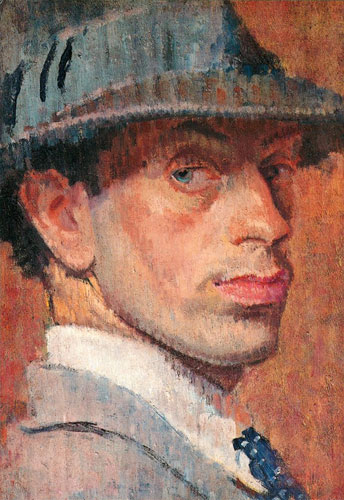
As opportunities in the Arts disappeared, he made plans to enlist with the RAMC. In 1915 Rosenberg joined the only battalion that would accept men of his short stature, the Bantam’s of the 12th Suffolks.(3) Physically frail and with a recurrent lung condition he found army life unyielding ‘sent from unit to unit and task to task'.(4)
In the Summer of 1917 assigned to the RE unit of the King’s Own Royal Lancaster’s he composed ‘Returning we hear the Larks’.(5) Here the sky has a ‘beauty that can hide a storm of death as easily as it produces music’, and Rosenberg becomes a spokesman for all the ironies of war that can never be explained.(6)
Private Rosenberg re-joined the KOR’s in the trenches just prior to the German Spring Offensive. On the 28 March the 3rd Army found themselves on the new front line as the Germans broke through again. Survivors were ordered back for respite, yet Rosenberg remained. On the night of 1 April 1918, he set off on wiring patrol, but did not return.(7)
Through the tireless efforts of his sister Annie and Georgian Poet, Gordon Bottomley, a volume of his works(8) including ‘Break of Day in the Trenches’(9) was published following his death.
RETURNING, WE HEAR THE LARKS by Isaac Rosenberg
Sombre the night is:
And, though we have our lives, we know
What sinister threat lurks there.
Dragging these anguished limbs, we only know
This poison-blasted track opens on our camp -
On a little safe sleep.
But hark! Joy - joy - strange joy.
Lo! Heights of night ringing with unseen larks:
Music showering on our upturned listening faces.
Death could drop from the dark
As easily as song -
But song only dropped,
Like a blind man’s dreams on the sand
By dangerous tides;
Like a girl’s dark hair, for she dreams no ruin lies there,
Or her kisses where a serpent hides.
Nemo enim ipsam voluptatem quia voluptas sit aspernatur aut odit aut fugit, sed quia consequuntur magni dolores eos qui ratione voluptatem sequi nesciunt. Neque porro quisquam est, qui dolorem ipsum quia dolor sit amet, consectetur, adipisci velit, sed quia non numquam eius modi tempora incidunt ut labore et dolore magnam aliquam quaerat voluptatem.
Nemo enim ipsam voluptatem quia voluptas sit aspernatur aut odit aut fugit, sed quia consequuntur magni dolores eos qui ratione voluptatem sequi nesciunt. Neque porro quisquam est, qui dolorem ipsum quia dolor sit amet, consectetur, adipisci velit, sed quia non numquam eius modi tempora incidunt ut labore et dolore magnam aliquam quaerat voluptatem.
Nemo enim ipsam voluptatem quia voluptas sit aspernatur aut odit aut fugit, sed quia consequuntur magni dolores eos qui ratione voluptatem sequi nesciunt. Neque porro quisquam est, qui dolorem ipsum quia dolor sit amet, consectetur, adipisci velit, sed quia non numquam eius modi tempora incidunt ut labore et dolore magnam aliquam quaerat voluptatem.
Self Portrait Isaac Rosenberg - oil on panel - 1915
(Painted in the year Rosenberg enlisted. Despite being a pacifist, he believed ‘we must all fight to get the trouble over.’)
Given by the sitter's sister, Annie Wynick (née Rosenberg), 1959
Notes:
1. Ed. Powell, Ann, A Deep Cry; Soldier-Poets killed on the Western Front, The History Press (2014), page 350
2. London Jews of the First World War - www.jewsfww.london
3. Ibid, A Deep Cry, page 351
4. Moorcroft Wilson, Jean, Isaac Rosenberg page 390-1 – A Century Back Feb 2018
5. Rosenberg, Isaac - Returning, we hear the Larks - Ed. Bottomley, Gordon, William Heinemann (London) (1922)
6. Stephen, Martin, Poetry & Myths of the Great War, Pen & Sword Military Books (2014), page 219
7. Ibid, A Deep Cry, page 360
8. Ibid Poetry & Myths of the Great War, page 212
9. Rosenberg, Isaac - Break of Day in the Trenches - First published Dec 1916 Issue Chicago journal ‘Poetry’
Robert Graves
Robert Graves and close friend Siegfried Sassoon served as Officers in the Royal Welch Fusiliers, though neither were Welshmen.(1) Graves also spent time with the Welsh Regiment and in ‘Good-bye to All That’ tells of reaching the trenches for the first time, under bombardment;

Instead of the usual music-hall songs they sung Welsh hymns, each man taking a part. The Welsh always sang when pretending not to be scared; it kept them steady…… a salvo of four shells whizzed suddenly over our heads. This broke up ‘Aberystwyth’ in the middle of a verse… (2)
Alfred Perceval Graves was an Inspector of Schools and celebrated Irish Poet, (3) his Mother, Amalie von Ranke, the great niece of historian Leopold von Ranken. On accepting his commission in 1914 Robert noted this would put right the ‘family balance’ with ‘ten members fighting on each side’.(4)
In July 1916 leading his men through a cemetery at the Somme, Captain Graves was wounded in the lung by a shell blast and not expected to ‘last the night’. His commanding officer wrote of his death and an obituary was printed in ‘The Times’ before he arrived back in England surviving a five-day journey without a change of bandages.(5)
Suffering from shell-shock he remained traumatised by the war throughout his life. After divorce from his first wife Nancy and the breakup of his affair, Graves left England for Mallorca with his second muse, Beryl.(6) Settling with his new family he continued to write publishing a total of 140 books including the famous I, Claudius, The White Goddess and The Greek Myths.(7)
IT'S A QUEER TIME by Robert Graves (extract)
It’s hard to know if you’re alive or dead
When steel and fire go roaring through your head.
One moment you’ll be crouching at your gun
Traversing, mowing heaps down half in fun:
The next, you choke and clutch at your right breast -
No time to think - leave all - and off you go…
To Treasure Island where the Spice winds blow,
To lovely groves of mango, quince and lime -
Breathe no good-bye, but ho, for the Red West!
It’s a queer time.
You’re charging madly at them yelling ‘Fag!’
When somehow something gives and your feet drag.
You fall and strike your head; yet feel no pain
And find… you’re digging tunnels through the hay
In the Big Barn, ‘cause it’s a rainy day.
Oh, springy hay, and lovely beams to climb!
You’re back in the old sailor suit again.
It’s a queer time.....
Nemo enim ipsam voluptatem quia voluptas sit aspernatur aut odit aut fugit, sed quia consequuntur magni dolores eos qui ratione voluptatem sequi nesciunt. Neque porro quisquam est, qui dolorem ipsum quia dolor sit amet, consectetur, adipisci velit, sed quia non numquam eius modi tempora incidunt ut labore et dolore magnam aliquam quaerat voluptatem.
Nemo enim ipsam voluptatem quia voluptas sit aspernatur aut odit aut fugit, sed quia consequuntur magni dolores eos qui ratione voluptatem sequi nesciunt. Neque porro quisquam est, qui dolorem ipsum quia dolor sit amet, consectetur, adipisci velit, sed quia non numquam eius modi tempora incidunt ut labore et dolore magnam aliquam quaerat voluptatem.
Nemo enim ipsam voluptatem quia voluptas sit aspernatur aut odit aut fugit, sed quia consequuntur magni dolores eos qui ratione voluptatem sequi nesciunt. Neque porro quisquam est, qui dolorem ipsum quia dolor sit amet, consectetur, adipisci velit, sed quia non numquam eius modi tempora incidunt ut labore et dolore magnam aliquam quaerat voluptatem.
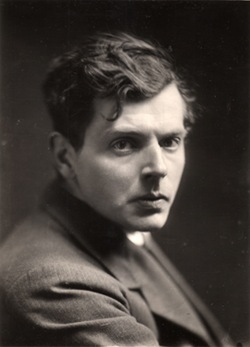
Robert Graves in old age
Notes:
1. www.movehimintothesun.wordpress.com - Griffiths, G.M. (1 March 2011)
2. Graves, Robert, Goodbye to All That - An Autobiography, Jonathan Cape, London (1929)
4. Ed. Kendall, T, Poetry of the First World War, Oxford University Press (2017), page 192
5. Shute, Joe, (Mallorca), My father Robert Graves, the war poet who cheated death, The Telegraph (23 July 2016)
7. Ibid
Francis Brett Young
Francis Brett Young began his medical career as a ship’s surgeon aboard the S.S. Kintuck sailing to the Far East.(1) On his return he set up practice at Brixham where his patients were mainly fisherman and sailor folk.(2) His wife, Jessica, established herself as a singer and Francis began a lifelong arrangement of accompanying her on the piano.(3)
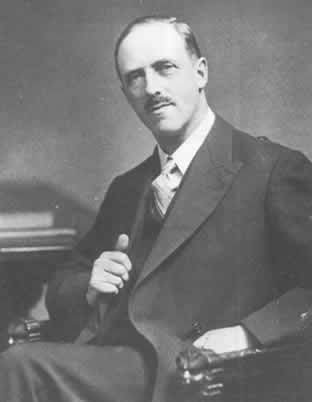
Volunteering for the RMAC, Brett Young was commissioned Lieutenant on 1 January 1916, and received his posting to South East Africa under the command of General Smuts. On arrival he was appointed Medical Officer to the Second Rhodesian Regiment and sent immediately to the front.(4)
Traversing the unforgiving landscape, Brett Young shepherded his injured charges through the “tracts of rolling bush and plain over which the shadow of man’s spirit had never moved before…”.(5) During the advance to Makindu, surrounded on three sides by German forces and with hundreds of casualties in the care of the field ambulance, he penned ‘After Action’.(6)
Weakened by constant malaria Captain Brett Young was despatched back to England in January 1917. He turned to his writing publishing ‘Marching on Tanga', (7) ‘Five Degrees South’ and ‘Poems’.(8)
After the war the couple moved to Capri forging new friendships with literary neighbours, Compton McKenzie and D.H. Lawrence. Here Francis began the popular Mercian series including the acclaimed ‘Portrait of Clare’.(9) They returned to their native West Midlands until the end of WW2 when the breakdown of Francis’ health prompted a departure to South Africa. Brett Young died in Cape Town in 1954. His ashes were interred in Worcester Cathedral.
AFTER ACTION by Francis Brett Young
All through that day of battle the broken sound
Of shattering Maxim fire made mad the wood;
So that the low trees shuddered where they stood,
And echoes bellowed in the bush around:
But when, at last, the light of day was drowned,
That madness ceased... Ah, God, but it was good!
There in the reek of iodine and blood,
I flung me down upon the thorny ground.
So quiet was it, I might well have been lying
In a room I love, where the ivy cluster shakes
Its dew upon the lattice panes at even:
Where rusty ivory scatters from the dying
Jessamine blossom, and the musk-rose breaks
Her dusky bloom beneath a summer heaven.
Nemo enim ipsam voluptatem quia voluptas sit aspernatur aut odit aut fugit, sed quia consequuntur magni dolores eos qui ratione voluptatem sequi nesciunt. Neque porro quisquam est, qui dolorem ipsum quia dolor sit amet, consectetur, adipisci velit, sed quia non numquam eius modi tempora incidunt ut labore et dolore magnam aliquam quaerat voluptatem.
Nemo enim ipsam voluptatem quia voluptas sit aspernatur aut odit aut fugit, sed quia consequuntur magni dolores eos qui ratione voluptatem sequi nesciunt. Neque porro quisquam est, qui dolorem ipsum quia dolor sit amet, consectetur, adipisci velit, sed quia non numquam eius modi tempora incidunt ut labore et dolore magnam aliquam quaerat voluptatem.
Nemo enim ipsam voluptatem quia voluptas sit aspernatur aut odit aut fugit, sed quia consequuntur magni dolores eos qui ratione voluptatem sequi nesciunt. Neque porro quisquam est, qui dolorem ipsum quia dolor sit amet, consectetur, adipisci velit, sed quia non numquam eius modi tempora incidunt ut labore et dolore magnam aliquam quaerat voluptatem.
Francis Brett Young
Notes:
1. Hall, Michael, Francis Brett Young, Poetry Wales Press Ltd, Bridgend (1997)
2. Swinton, W.E., Physicians in literature. Part VIII: yet to be discovered: Francis Brett Young, CMA Journal Vol 114 page 557 (20 March 1976)
3. Ibid page 557
4. Ibid Francis Brett Young (1997)
5. Brett Young, Francis, Marching on Tanga, William Collins, London (1918) page 182
6. Brett Young, Francis - After Action - Poems 1916-18, W Collins, Sons & Co Ltd, London (1919) page 50
7. Ibid Marching on Tanga (1918)
8. Brett Young, Francis, Five Degrees South, Martin Secker, London (1917) and Poems 1916-18, W Collins, Sons & Co Ltd, London (1919)
9. www.fbysociety.co.uk - James Tait Black Memorial Prize 1927 – Portrait of Clare

_cropped_and_retouched.jpg)
© Copyright 2026. All rights reserved.


