Ewart Alan Mackintosh 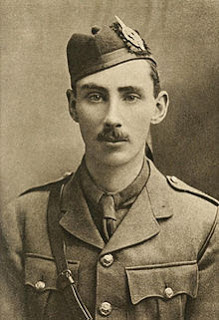

Ewart Alan Mackintosh was rejected by the Army for his poor eyesight. He persisted and finally joined the Ross-shire Buffs as Second Lieutenant, 5th Seaforth Highlanders, on 1 January 1915. Although born in Brighton he was extremely proud of his Scottish heritage and his paternal family home in Easter Ross.(1)
On 16 May 1916 Mackintosh, known as ‘Tosh’,(2) led 50 of his men through the Labyrinth on a retaliation raid in the fading light. After returning two badly injured men to safety, he carried young David Sutherland 100 yards under heavy fire, only to lose him as they tried to lift him out of the deep trench. He wrote to his sister Muriel;
“I’d promised the men I wouldn’t leave the Bosche trench while
there was a man alive in it and I kept my word…. All the men I have
brought back have died”(3)
Awarded the Military Cross for his courageous actions, Mackintosh never recovered from the pain of losing his men. Three months later wounded and gassed at High Wood he was transported back to England.(4)
During recovery he trained cadets in bombing techniques at Cambridge, where he finalised arrangements to publish ‘A Highland Regiment’ and became engaged to VAD Nurse, Sylvia Marsh.(5) But the memories of the men he fought with were too strong and he returned to the Front on 3 October 1917.(6)
Six weeks after joining the 4th Seaforth Highlanders Lieutenant Mackintosh was shot in the head whilst observing enemy movements in the midst of the advance on the 2nd day of the Battle of Cambrai.(7)
IN MEMORIAM by E.A. Mackintosh (Extract)
Pvte D Sutherland killed in action in the German
trench May 16, 1916 and the others who died
So you were David’s father,
And he was your only son,
And the new-cut peats are rotting
And the work is left undone,
Because of an old man weeping
Just an old main in pain,
For David, his son David
That will not come again.
Oh the letters that he wrote you,
And I can see them still,
Not a word of the fighting
But just the sheep on the hill
And how you should get the crops in
Ere the year get stormier,
And the Bosches have got his body,
And I was his officer.
You were only David’s father,
But I had fifty sons
When we went up in the evening
Under the arch of the guns,
And we came back at twilight -
O God! I heard them call
To me for help and pity
That could not help at all......
...Happy and young and gallant,
They saw their first-born go,
But not the strong limbs broken
And the beautiful men brought low,
The piteous writhing bodies,
They screamed ‘Don’t leave me, sir,’
For they were only your fathers
But I was your officer.
Nemo enim ipsam voluptatem quia voluptas sit aspernatur aut odit aut fugit, sed quia consequuntur magni dolores eos qui ratione voluptatem sequi nesciunt. Neque porro quisquam est, qui dolorem ipsum quia dolor sit amet, consectetur, adipisci velit, sed quia non numquam eius modi tempora incidunt ut labore et dolore magnam aliquam quaerat voluptatem.
Nemo enim ipsam voluptatem quia voluptas sit aspernatur aut odit aut fugit, sed quia consequuntur magni dolores eos qui ratione voluptatem sequi nesciunt. Neque porro quisquam est, qui dolorem ipsum quia dolor sit amet, consectetur, adipisci velit, sed quia non numquam eius modi tempora incidunt ut labore et dolore magnam aliquam quaerat voluptatem.
Nemo enim ipsam voluptatem quia voluptas sit aspernatur aut odit aut fugit, sed quia consequuntur magni dolores eos qui ratione voluptatem sequi nesciunt. Neque porro quisquam est, qui dolorem ipsum quia dolor sit amet, consectetur, adipisci velit, sed quia non numquam eius modi tempora incidunt ut labore et dolore magnam aliquam quaerat voluptatem.
E.A. Mackintosh - iwm.org.uk
Notes:
1. Campbell, Colin and Green, Rosalind, ‘Can’t shoot a man with a cold’ Lt. E. Alan Mackintosh MC 1893-1917 Poet of the Highland Division, Argyll Publishing, Argyll (2004) page 82
2. Ibid page 210
3. Intro by Coningsby Dawson, War, The Liberator and Other Pieces by E.A. Mackintosh, MC, John Lane, The Bodley Head (1918)
4. Murray, John, Memoir- Christ Church, Oxford April 1918, Ibid War, The Liberator
5. Ibid
6. 4th Seaforths’ battalion war diary, Queen’s Own Highlanders Museum, Inverness
7. E.A. Mackintosh obituary in The Times, Tuesday 4th December 1917
© Copyright 2026. All rights reserved.


